
Post Preview
Table of Contents
Key Takeaways
- Self-service technologies are increasingly preferred by travelers for their convenience and efficiency.
- Implementing these solutions can lead to significant operational cost savings for hospitality providers.
- Challenges such as technological integration and maintaining personalized service must be addressed.
Table of Contents
- Rising Demand for Self-Service Solutions
- Benefits of Self-Service Technology
- Challenges in Implementation
- Real-World Examples
- Future Trends
- Conclusion
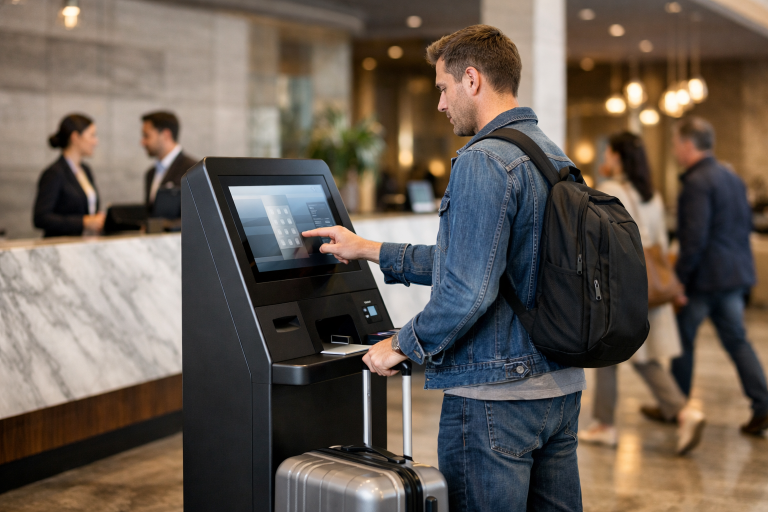
In the rapidly evolving hospitality sector, self-service technology stands at the forefront of change, driving both guest satisfaction and operational efficiency. As hotels and accommodation providers upgrade their offerings, hospitality kiosk solutions have become a key consideration for businesses aiming to meet modern travelers’ needs with convenience and speed. Whether checking in late at night or managing reservations from a smartphone, guests increasingly gravitate toward services that offer autonomy and reduce waiting times.
Travelers’ expectations have shifted dramatically in recent years, pressuring hotels to adapt quickly. According to industry data, a majority of guests now favor automated check-ins and digital options for managing their stays, which allow them to sidestep traditional front desk queues and customize their experience. Hospitality providers expanding into self-service technology invest not only in improved guest experiences but also in streamlined operations that translate to cost savings and more focused staff time.
With these self-serve options, properties enjoy greater operational flexibility. Staff, relieved from repetitive tasks, can focus on delivering personalized customer service, cultivating loyalty, and addressing unique guest needs. The shift is not without its challenges, but the benefits, from time savings to reducing overhead, are driving widespread adoption in the hotel industry.
Recent research from trusted sources like Hospitality Technology reinforces these trends, highlighting the growing role of automation and AI in shaping the guest experience and enforcing security protocols throughout the hospitality journey. This article will explore the current landscape, benefits, challenges, and emerging trends in self-service hospitality solutions.
Rising Demand for Self-Service Solutions
Recent studies point to a marked shift in traveler preferences, with guests seeking more control over their stay and greater access to on-demand services. For example, a notable survey conducted by Mews found that nearly 80 percent of travelers would consider staying at hotels with a fully automated lobby or self-service kiosks. These findings highlight that convenience and efficiency are not just trends, but guest expectations that challenge traditional hospitality models.
Self-serve kiosks and digital check-in systems can also address crucial needs for international travelers or guests arriving late in the evening, accommodating language barriers and providing seamless integrations with identification technology and payment options. Furthermore, in the context of pandemic recovery, the preference for contactless and autonomous service has been amplified, accelerating the adoption of self-service hospitality tools globally. For more on this trend and how it’s changing travel, see analyses from Skift.
Benefits of Self-Service Technology
- Enhanced Guest Experience: Guests benefit from reduced wait times during check-in and check-out, personalized options such as choosing room features, and the ability to manage their stay from their own devices.
- Operational Efficiency: Automating essential but repetitive processes allows hospitality teams to optimize workflows, ensuring that trained staff can focus on complex guest requests and high-touch customer service moments.
- Cost Savings: By reducing labor-intensive transactions at the front desk, hotels can minimize workforce costs and reallocate resources to areas driving greater revenue or competitive differentiation.
Additionally, the implementation of self-service solutions can lead to more accurate data collection, useful for revenue management and targeted marketing. The shift to a more digital guest journey further empowers hotels to better understand guest preferences and behaviors, supporting both operational and strategic decision-making. Self-service platforms allow hotels to analyze trends and feedback efficiently, resulting in more agile responses to guest demands and improved service delivery. By combining automated efficiency with data-driven intelligence, businesses can stand out in a highly competitive hospitality industry.
Challenges in Implementation
- Technological Integration: Adopting these solutions often requires seamless integration with existing property management systems, payment solutions, and third-party apps, which may demand substantial time and investment.
- Maintaining Personalization: One of the most significant hurdles is preserving personalized hospitality in an automated environment. It is crucial that hotels balance automation with human touchpoints, ensuring guests do not feel isolated by technology.
- Security Concerns: Protecting sensitive guest data and ensuring secure digital transactions are major priorities. With increasing reliance on digital systems, cybersecurity measures must be continually updated to prevent data breaches and maintain guest trust.
Many hotels also face organizational resistance, as longtime staff and management adapt to new operational models. According to experts cited by Forbes, ongoing training and transparent communication are critical to successful technological transitions.
Real-World Examples
- Stayntouch: This provider experienced a 72 percent increase in hotels turning to its kiosk solutions, showing a clear demand for automated check-in among modern travelers.
- Trybe: Pioneered the integration of wearable wristband technology and self-service kiosks, streamlining the verification process and facilitating cashless transactions throughout the property for guests of all ages.
Global brands like Marriott and Hilton are piloting digital room keys and mobile check-in, further validating industry-wide momentum towards a more tech-savvy, guest-centric future.
Future Trends
- Integration with Mobile Devices: Advanced mobile apps are enabling guests to check in, access rooms, and order services directly from their smartphones.
- Artificial Intelligence: AI-driven platforms are being deployed to anticipate guest needs, provide tailored recommendations, and resolve requests more efficiently via chatbots and virtual concierges.
- Contactless Solutions: The expansion of NFC and QR code technologies promises an even smoother and safer guest journey, minimizing physical touchpoints while maximizing convenience.
This evolution reflects a broader movement in the service industry, where flexibility, speed, and personalization powered by technology are critical to competitiveness and guest loyalty. More innovations are anticipated, including augmented reality (AR) for wayfinding and personalized guest experiences, as well as further advancements in biometric authentication to streamline access control and payments.
Conclusion
In summary, self-service technology is reshaping the hospitality industry by aligning with guests’ growing expectations for autonomy and efficiency. While integrating these solutions presents challenges in system compatibility, personalization, and security, the benefits for both guests and operators are substantial. As technology continues to evolve, hospitality providers who prioritize seamless self-service options and innovative digital experiences will be well-positioned to thrive in a dynamic and competitive market landscape.