
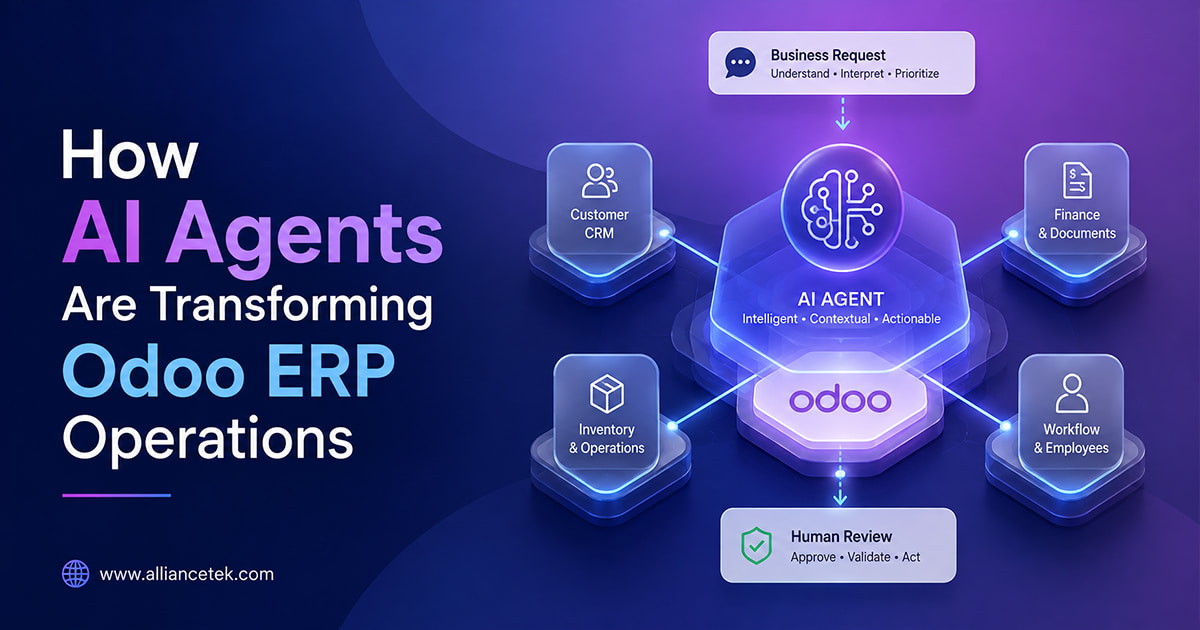
Odoo ERP can automate many processes, but there are ample tasks that involve information and requests where employees need to understand the context and decide what to do. This type of activity can lend itself well to AI agents.
AI agents can help in ERP systems by working through the steps that the system allows. They understand the information involved and take action based on it. The use of AI agents for ERP to solve document management problems, communication with customers, inventory management, and analysing various processes is appropriate, leaving managerial decisions to humans.
Table of Contents
What Are AI Agents in Odoo ERP?
An AI agent is defined as an intelligent computer program that can gather data and act toward a certain objective. When connected with Odoo, an AI agent can perform activities using information from various ERP modules as well as the workflows it has access to.
For instance, an AI agent can receive a request from a client, understand the client’s requirements, get the necessary information from Odoo, and pass the request to the required workflow or employee.
AI agents neither replace Odoo nor its existing automation processes. Instead, they add another layer for working with information and performing tasks that require more context than a predefined rule can provide.
How Are AI Agents Changing Odoo ERP Operations?
AI agents can be applied to several areas of an Odoo environment.
1. Automating Repetitive Activities
ERP systems include repetitive activities such as information capturing, data verification, status updating, and request routing. As an illustration, an AI agent could:
- Read an incoming message and recognise what the client wants
- Identify the relevant customer or business record in Odoo
- Update the required information
- Assign the task to the appropriate employee
- Start the relevant workflow
2. Improving Document and Invoice Handling
Various documents, like invoices and purchase orders, are provided to businesses in different formats, making manual analysis a difficult task.
AI agents can extract key details and compare them with Odoo records. If the information matches, the workflow can continue; unusual values or missing details can be flagged for employee review.
This is one area where AI-powered ERP automation can complement existing Odoo workflows.
3. Enhancing Customer Management
Customer service teams need to look for various records in their work. AI agents can be used to retrieve information from CRM, previous communications, orders, and other relevant sources.
Using the right Odoo development services, businesses can implement workflows where AI implements functionalities such as:
- Summarizing customer communication
- Classifying inquiries
- Searching for customer information
- Dispatching inquiries to appropriate employees
- Drafting replies for employees
Ultimately, the employee will remain the one making the decision.
4. Assisting Inventory and Supply Chain Operations
Inventory management is a process in which one monitors inventory quantities, orders, suppliers, and movement of products. AI agents will be used to detect information that needs action.
For instance, the agent could detect that inventory of a particular product is reaching its threshold and alert the employee responsible for the task. Other processes could include integration of information from sales, inventory, and purchasing to offer advice.
This is valuable as it links information without employees having to go through different documents.
5. Personalizing ERP Workflows
Every company uses Odoo in its own way, so AI agents can be tailored to their workflow, guidelines, software, and information resources.
Companies can make agents for:
- Sales
- Support
- Finance
- Procurement
- HR
- Manufacturing
It enables agents to access necessary information and permissions, which is important for making AI more useful in the Odoo environment.
AI Agents vs. Traditional Odoo Automation
Both approaches can automate Odoo workflows. They differ in handling tasks and making decisions.
| Aspect | Traditional Odoo Automation | AI Agents in Odoo |
| How it works | Follows predefined rules and workflows | Interprets information and determines the next action |
| Best for | Repetitive, predictable tasks | Tasks requiring context or interpretation |
| Decision-making | Based on fixed conditions | Can assess information within defined limits |
| Data handling | Works with structured data | Can work with text, documents, and structured data |
| Flexibility | Changes require workflow updates | Can adapt to different inputs and situations |
| Example | Automatically update inventory after an order | Review an order, identify an issue, and route it for review |
What Role Does Odoo Development Play?
Access to relevant data, procedures, rights, and systems is required for AI agents to do valuable tasks. Odoo development services may help with the implementation of AI from the technical perspective.
Depending on the requirement, the development could include such steps as API development, customization of an existing module, linking of AI services to Odoo, and workflow development for an agent.
Connecting AI With Other Business Systems
Odoo integration services help to connect to external applications for relevant information sharing. For example, the AI agent may collaborate with the data coming from an e-commerce application and Odoo’s stock and customer data, thereby giving complete details about the order.
What Should Businesses Consider Before Using AI Agents?
AI agent use can be beneficial when implemented correctly.
- Quality of Data: To produce meaningful results, AI needs accurate data.
- Safeguard: Access to data needs to be restricted only to that required for the completion of a particular task.
- Human Oversight: Important decisions still may need to be made by employees.
- Running Tests: The agent’s functionality should be tested before use in production.
- Clear Objectives: A specific problem needs to be understood before starting the AI agent implementation.
Once a business starts using the AI agent in a well-defined and simpler process, chances to measure the value of this technology become greater.
Conclusion
AI Agents are making the Odoo ERP system more responsive by enabling companies to automate processes, deal with information, and make decisions daily. It is important that these agents do not just replace manual actions, but enable more efficient and manageable processes within the existing workflows.
A company may begin with one or two use cases and develop further based on its needs and requirements. The Odoo Development Services allow integration of the abilities of AI into the workflow while maintaining security and accuracy.
Want to know how AI agents can improve your Odoo operations? AllianceTek can help you identify practical use cases and build the right solution for your business.